

In 2025, OQGN made significant progress toward its strategic agenda by strengthening and expanding its national gas network, advancing new growth ventures, and driving operational excellence across the business.
The Company continued to accelerate innovation and digital transformation, invest in its people, and actively support Oman’s sustainability and energy-transition objectives. These efforts collectively reinforced OQGN’s financial resilience and positioned the company for sustainable long-term value creation.
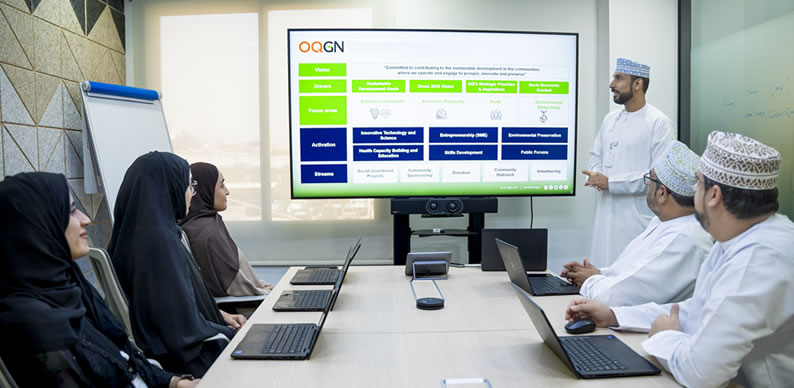
| Strategic Objectives | Rationale | |
|
1 |
Gas Network Growth | Expand the natural gas network to meet peak demand by 2030, while leveraging regional opportunities to grow the footprint, boost service efficiency, and ensure reliable delivery of energy commodities |
|
2 |
New Venture Developments | Expand and optimize the infrastructure for hydrogen, CCUS, hydrocarbons, NGL and other infrastructure, aligning with national energy transition priorities and future delivery demands. |
|
3 |
Business Excellence | Improve efficiency through operational excellence, innovation and digitalization |
|
4 |
People & Culture Development | Develop OQGN's talent by fostering a nourishing culture, promoting learning and development and attracting top talent |
|
5 |
Sustainability Leadership | Consolidate sustainability (incl. ESG) related efforts to work towards Oman's Net Zero and decarbonization vision |
|
6 |
Financial Excellence | Given success of the IPO, financial focus is shifting towards new financing mechanisms, debt restructuring, and ensurance of Sharia compliance |
Operational Excellence and System Integrity
100%
Zero outages in 2025
Gas Availability
4,368 km
total network
Pipeline Length
42.4
BCM in 2025
Total Gas Delivered
130+
annual gas consumers
Consumers Served
OQGN’s performance in 2025 continued to set a national benchmark for reliability and system stability, ensuring that gas flows were optimally balanced and efficiently delivered across Oman’s industrial, commercial, power generation, and LNG sectors. Availability of gas was successfully maintained at 100% with zero interruptions, an improvement over the previous year, which recorded one outage.
The national pipeline length increased to 4,368 km, up from 4,235 km in the previous year, reflecting the Company’s continuous expansion of its infrastructure footprint to meet future demand. Simultaneously, total gas delivered during the year reached 42.4 BCM, underpinned by robust offtake from key segments. Delivery volumes were primarily driven by Oman LNG (17.0 BCM) and the Industrial & Commercial sector (11.8 BCM).
Gas Volumes — Three-Year Comparison
In line with this operational strength, OQGN also advanced several key initiatives to reinforce system integrity and enhance efficiency. A key achievement to the company is obtaining the ISO 50001 Energy Management System certification, reflecting its commitment to responsible and efficient energy use. The Alarm Management Solution elevated safety and reliability by reducing nuisance alarms, improving operator response, minimizing downtime, and supporting industrial standards. The rollout of Cathodic Protection (CP) Online/Remote Monitoring introduced an automated and proactive monitoring system for transformer rectifiers and solar cathodic protection controllers, ensuring the correct levels of protection across the network. Additionally, the implementation of KW Signal to Distributed Control System introduced reliable, real-time monitoring of electrical heater energy consumption, providing high-quality data to support benchmarking, reporting, and ongoing performance improvement.
This continued efficiency in delivery performance enhanced overall supply flexibility and further reinforced OQGN’s deep expertise in managing a complex, nationwide pipeline network and its capability to support Oman’s long-term growth trajectory.

Infrastructure Expansion Through Project Delivery
In 2025, OQGN continued to advance in its strategic infrastructure agenda, with several large-scale national projects moving through engineering and construction phases.
| Project | Scope & Impact | CAPEX (X) | Capacity Add | Status |
| Marsa LNGB |
2.8 km, 20” pipeline + fiscal metering at Sohar
Port. Enables ~1 MTPA LNG for marine bunkering
(green–fuel hub). Customer–funded. |
13.98 Mn. | 1 MTPA LNG | In Progress |
| 42” Fahud–Sohar Loop Line | 193 km loop line, Fahud to Sohar. Adds 11 MMSCMD to North Gas Network by 2027, supporting Sohar & Ibri industrial growth. | 104.22 Mn. | 11 MMSCMD | In Progress |
| Budoor Tayseer Gas Plant |
31 km, 14” pipeline from Budoor Tayseer to SGL PL tie–in at BVS–15. | 9.66 Mn. | 2 MMSCMD | Approved |
| Duqm Port Gas Supply | 13 km, 32” pipeline serving Jindal Steel Duqm and Duqm Port customers. | 14.06 Mn.* | – | Approved |
| Duqm & Misfah IPPs |
Gas connection for two IPPs: Duqm (4.4 MMSCMD) +
Misfah (8.4 MMSCMD). Customer–funded. |
38.33 Mn. | 12.8 MMSCMD | Approved |
*Combined CAPEX including both transportation and connection projects.
Driving Network Growth, Energy Transition Infrastructure, and Business Excellence
OQGN’s strategic ambitions are mainly aimed at strengthening the national gas network, enabling major future-oriented energy transition initiatives, and embedding business excellence and digital innovation across the organization. Through a combination of infrastructure expansion, strategic studies, international partnerships, and digital transformation efforts, the company demonstrated strong performance aligned with its long-term goals. The accomplishments highlighted underscore the importance in ensuring that OQGN continues to operate as a trusted and future-ready steward of Oman’s gas transportation system.
OQGN actively progressed growth opportunities by completing several concept studies and business cases. These included studies to connect new potential suppliers, maximize natural projects and secure high-quality gas supply for future mega-projects, and develop curtailment philosophy support studies in collaboration with IGC. These studies serve as the foundation for future system expansion and ensure OQGN remains ready to meet anticipated demand growth.
OQGN strengthened its national network consolidation by achieving several key asset acquisitions, including the 65 km 36” BP Ghazeer pipeline and the Fahud NGLE gas transportation and connection asset, valued at X 39.90 Mn and X 1.26 Mn respectively.
The company has also managed to secure the necessary internal and external approvals for several major capital projects forming part of the network’s 2025 expansion pipeline. These approvals enabled the progression of key growth opportunities such as the Budoor Tayseer Gas Plant Project (31 km, 14” pipeline, CAPEX X 9.66 Mn, adding 2 MMSCMD of capacity) and the Duqm Port Gas Supply Project (13 km, 32” pipeline, CAPEX X 14.06 Mn). In addition, connection project proposals for the Duqm and Misfah IPPs were endorsed, paving the way for a combined 12.8 MMSCMD of new transmission capacity to be incorporated into future network planning.
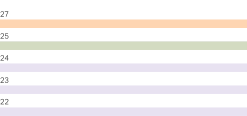
These network growth projects align the company’s vision with the long-term objective of expanding pipeline capacity to nearly 80 BCM by 2027.
Network capacity growth (BCM)
Energy Transition Infrastructure
In 2025, OQGN strengthened its role as a national enabler of Oman’s energy transition by progressing major initiatives in green hydrogen, carbon capture, utilization and storage (CCUS), and low-carbon infrastructure development. This work reflects OQGN’s strategic mandate as the National Hydrogen and CO₂ Network Operator (HNO/CNO) and its growing role in shaping Oman’s future energy corridors.
OQGN worked on developing the national Green Hydrogen Pipeline Infrastructure Masterplan, ensuring that the pipeline network concept aligns with the technical and commercial needs of emerging hydrogen projects. The company successfully engaged with key stakeholders across the hydrogen value chain, achieving consensus on the equity-risk considerations necessary for national champions participating in early-stage hydrogen pipeline projects.
On the Carbon Capture, Utilization, and Storage (CCUS) front, the company advanced the development of the Northern CCUS Ecosystem, driven by strong CO₂ demand from oil operators seeking CO₂ for Enhanced Oil Recovery (EOR) and meaningful supply sources from major industrial emitters. OQGN also launched a CO₂ Network Expression of Interest as a market engagement exercise to assess CO₂ supply and demand dynamics across the country and understand user requirements for a potential CO₂ network.